
Best travel adapter for international use usually means one thing in real life: you plug in at 11 p.m. in a hotel abroad and your phone actually charges, safely, without playing outlet roulette.
The problem is most “international adapters” look similar online, yet they behave very differently once you add fast charging, a laptop, multiple devices, or older hotel wiring. Some are basically plug shapers, some add USB charging, and a few try to be an all-in-one travel power hub.
This guide breaks down what matters in 2026, how to choose by destination and devices, what to avoid, and a few practical setups that work for most US travelers.
Quick take: what makes a travel adapter “best” in 2026
In 2026, the “best” adapter is less about having every plug shape and more about power handling, USB-C charging, and basic safety features you can trust when you’re tired and in a hurry.
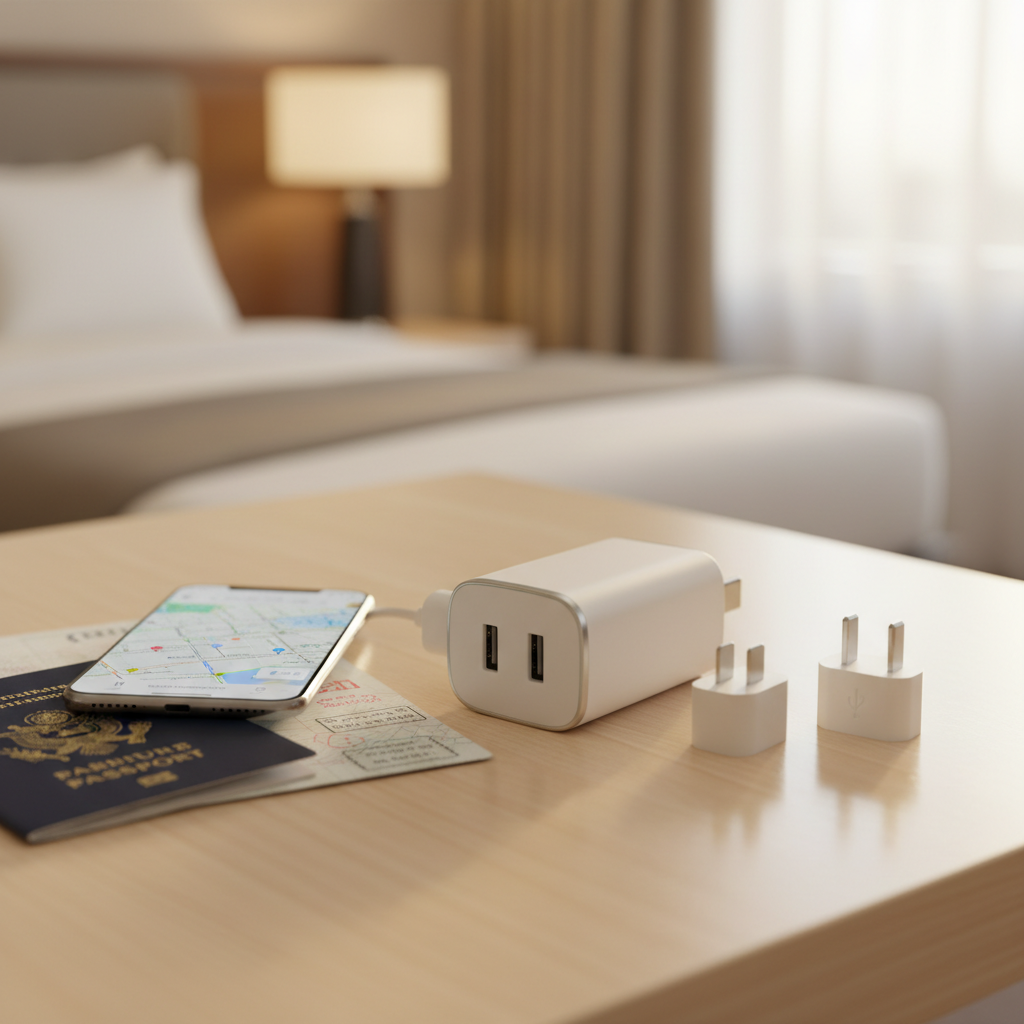
Key points worth remembering
- Adapters don’t convert voltage unless they explicitly say “voltage converter.” They mostly change plug shape.
- For modern chargers (phone, tablet, many laptops), you usually want multi-country plugs + USB-C PD.
- If you bring any heat-based appliance (hair dryer, straightener), you may need a converter or a dual-voltage device.
Adapter vs. converter: the difference that prevents expensive mistakes
Most confusion comes from treating “adapter” and “converter” as the same product. They’re not.
- Travel adapter: changes the plug shape so your US plug fits a foreign outlet. It does not change the electricity coming out of the wall.
- Voltage converter: changes voltage (for example, 220–240V down to ~110–120V) for devices that can’t accept international voltage.
According to U.S. Department of Commerce (International Trade Administration) materials on electrical standards, many countries run on 220–240V while the U.S. uses ~120V, and plug types vary by region. That mismatch is why the adapter vs. converter distinction matters.
If your device label says something like “Input: 100–240V, 50/60Hz”, it’s typically dual-voltage and you only need the plug adapter. If it says “120V only”, treat it as converter territory, or leave it at home.
How to choose the best travel adapter for international use (a practical checklist)
Here’s the short list I’d use if I were packing for a US-based trip that crosses borders, with no patience for trial-and-error.
1) Match plug types to your route, not the whole planet
Many “world adapters” cover the common plug families (EU, UK, AU, plus sometimes US). That’s fine, but check your actual itinerary.
- Europe often needs EU (Type C/E/F)
- United Kingdom / Ireland needs UK (Type G)
- Australia / New Zealand often needs AU (Type I)
Reality check: some countries use multiple socket types or have older outlets. That’s where a slightly bulkier “universal” unit can save you.
2) Prioritize USB-C PD (and enough watts)
USB-C Power Delivery (PD) is what makes one adapter feel “2026-ready.” If you carry a laptop, look for 45W–70W+ PD support. For phone-only trips, lower wattage can still work, but it may slow things down when charging multiple devices.
- Phone + earbuds: often fine with 20W–30W total
- Phone + tablet: 30W–45W feels smoother
- Laptop + phone: 65W+ reduces compromises
3) Decide if you need AC passthrough at all
Some adapters include one AC outlet plus USB. Others are USB-only travel chargers. If your life runs on USB-C, a strong USB-C charger plus a small plug adapter can be cleaner and safer than a “do everything” brick.
4) Look for safety basics, not marketing buzzwords
Look for clear statements about overload protection, short-circuit protection, and temperature control. According to UL Solutions, product safety evaluation and certification helps reduce electrical risks; for travel gear, it’s a reasonable signal when you’re comparing unfamiliar brands.
Comparison table: what to buy based on your travel style
This table is intentionally practical. It doesn’t assume one magic product fits every trip.

| Traveler type | What you should prioritize | Typical setup that works | What to avoid |
|---|---|---|---|
| Phone-only weekend | Small size, reliable plug fit | Simple plug adapter + compact USB-C charger | Bulky “world” bricks you never use |
| Work trip (laptop + phone) | USB-C PD 65W+, heat management | High-watt USB-C PD charger + region plug adapter | Low-watt multiport units that throttle |
| Family travel (many devices) | Multiple USB ports, stable wall grip | Universal adapter with multiple USB-C/USB-A ports | One-port chargers that create “charging fights” |
| Multi-country itinerary | Common plug coverage, durability | Universal adapter (EU/UK/AU) + USB-C PD | Adapters with loose sliding parts |
Self-check: do you actually need a converter?
Most US travelers don’t need a voltage converter for modern electronics, but a few categories still cause trouble. Use this quick check before you buy anything.
- Check the label on your device or power brick: “100–240V” usually means adapter-only.
- Heat tools (hair dryers, curling irons) often pull high wattage and can fail or overheat on 220–240V systems if not dual-voltage.
- Motors (some older shavers, small appliances) can behave unpredictably even with a converter, depending on frequency differences and build quality.
If you’re unsure, it’s often safer to bring dual-voltage devices, or plan to use the hotel’s appliance. If you’re traveling for an event and absolutely must use a specific tool, consider asking an electrician or the device manufacturer’s support what they recommend for your destination.
Real-world setups that keep charging simple
You can build a reliable kit without overthinking it. Here are setups that tend to travel well for US users.
Setup A: “USB-C first” (my default recommendation)
- One high-quality USB-C PD wall charger (enough watts for your laptop if needed)
- One small region plug adapter (EU or UK depending on your route)
- Two cables: USB-C to USB-C, plus USB-C to Lightning if you need it
This often beats a universal adapter brick because it’s modular: if one part fails, you replace one part, not the whole thing.
Setup B: “One-and-done universal adapter” (good for multi-country trips)
- Universal adapter covering EU/UK/AU
- USB-C PD included (verify wattage)
- A spare cable and a tiny backup charger in your day bag
Look closely at port layout and build. Some universal units get top-heavy in loose outlets, and then you’re holding it with one hand while you brush your teeth.
Setup C: “Family charging station”
- Universal adapter (or region adapter)
- Multi-port USB-C/USB-A charger with enough total wattage
- Short labeled cables per person
Labeling cables sounds silly until you’re in a dark hotel room negotiating whose cable is whose.
Common mistakes (and how to avoid them)
Most failures come from a few predictable moves, not bad luck.
- Assuming the adapter converts voltage: it usually does not, and that’s how devices get damaged.
- Buying the cheapest “universal” unit: loose plug mechanisms and poor heat handling show up fast on long trips.
- Overloading one adapter: running a laptop, hair tool, and camera charger through a tiny travel brick can cause overheating or tripping.
- Ignoring outlet placement: some hotel outlets sit behind beds or inside lamps, bulky adapters may not fit.
According to NFPA (National Fire Protection Association) guidance on electrical safety, overloading or using unsuitable electrical equipment can increase fire risk. For travel, that translates into a simple habit: if an adapter gets unusually hot, unplug it and switch to a lower load or a better charger.

Buying tips for 2026: what to look for on the product page
Product pages can be vague, so here’s what I look for when screening options quickly.
- Clear electrical ratings for AC and USB output (watts, amps, voltage)
- USB-C PD explicitly stated, not just “Type-C port”
- Physical size and whether it blocks adjacent outlets
- Grounding support if you use grounded laptop plugs in certain regions, though compatibility varies by destination sockets
- Brand support and warranty that’s realistic for a travel item you’ll beat up
If you’re selecting the best travel adapter for international use for work travel, put wattage and thermal safety above “number of countries.” For vacation travel, plug fit and compactness may matter more.
Conclusion: a simple way to pick the right adapter
If you want a low-drama choice, start by checking whether your devices are dual-voltage, then decide between a modular USB-C charger + plug adapter, or a universal adapter with strong USB-C PD.
The best travel adapter for international use is the one that matches your route, delivers enough wattage for your heaviest device, and stays stable in real outlets. If you do those three, most travel charging problems disappear.
If you’re packing this week, do two things: read the input voltage on your laptop/charger, and choose a wattage level that won’t force trade-offs when you charge two devices at once.
FAQ
- Do I need a universal travel adapter for Europe?
Usually you need an EU plug type, but if your trip includes the UK or multiple countries, a universal adapter can be more convenient than carrying two separate plug heads. - Will a travel adapter work with my MacBook or USB-C laptop?
Yes if your laptop charger supports 100–240V input, which many do. The key is ensuring your USB-C PD wattage is high enough, otherwise charging may slow under load. - Is it safe to charge multiple devices from one adapter?
Often yes, as long as the adapter and charger are rated for the total power draw. If the unit runs hot or the charging becomes inconsistent, reduce the load and use a higher-quality charger. - Why does my adapter feel loose in some hotel outlets?
Older outlets and worn sockets are common in some buildings, and universal adapters can be top-heavy. A smaller plug adapter plus a separate charger often sits more securely. - What should I do if my adapter has no ground pin?
Many travel adapters are ungrounded by design. For sensitive or high-power equipment, consider a setup that supports grounding where applicable, or consult the device maker for travel guidance. - Can I use a power strip internationally with an adapter?
Sometimes, but it depends on the strip’s voltage rating and the destination voltage. If it’s not rated for 100–240V, don’t risk it; use a travel-rated charger or buy a local strip. - How do I know if I need a voltage converter for a hair dryer?
Check the label. If it’s not dual-voltage and you’re going to a 220–240V country, you may need a converter, but many travel converters struggle with high-watt heat tools. In many cases, using a local dryer is simpler.
If you’re trying to pick a best travel adapter for international use for a specific itinerary and device list, it can be faster to decide your max wattage and the plug types you’ll hit, then choose between a modular charger setup or a universal brick that meets those numbers without running hot.