
How to write a travel journal effectively comes down to one thing: capturing what you noticed before your memory edits it into a highlight reel. If you’ve ever come home with 800 photos but only a blurry sense of what the trip felt like, you’re not alone.
A good travel journal is practical, not precious, it helps you remember moments, track routes and costs, and even tell better stories later. The trick is building a system you can keep doing when you’re tired, hungry, or rushing to the next place.

This guide gives you a realistic approach: what to write, when to write it, and a few formats that make journaling easier on the road. No pressure to be poetic, the goal is clarity and consistency.
Pick a journal style you’ll actually use
Most people quit because the format asks too much. Before you worry about “good writing,” choose a style that matches your trip pace and your personality.
- Quick-log (5 minutes/day): bullet points, short reflections, great for packed itineraries.
- Story-driven: one scene per day written like a mini-essay, best for slower travel.
- Photo-anchored: each entry starts from one photo, then you add context you can’t see in the image.
- Planner hybrid: combines schedule, costs, and notes, ideal for frequent travelers and work trips.
If you’re deciding between paper and digital, pick based on friction. Paper feels satisfying and distraction-free, digital wins for search, backups, and adding photos. Many travelers use both: quick notes on the phone, clean rewrite once every few days.
Know what to capture: the “3 layers” method
When people ask how to write a travel journal effectively, they usually mean “what do I even write about?” A helpful mental model is to capture three layers, you can do it in a paragraph or in bullets.
Layer 1: Facts (so future-you can reconstruct the day)
- Where you went, how you got there, time of day
- Weather, crowds, closures, wait times
- What you ate, where you stayed, costs you’ll want to remember
Layer 2: Sensory details (the stuff photos miss)
- Sounds on the street, smells in a market, texture of the air
- One specific visual detail: signage, colors, light
- Your body cues: tired feet, jet lag haze, adrenaline spike
Layer 3: Meaning (why it mattered)
- What surprised you, what felt hard, what felt easy
- Something you learned about a place or about yourself
- One small decision you’d repeat or change next time
Even on “boring” days, Layer 3 gives you something real to write. And yes, it’s normal if the meaning shows up later.
Use a repeatable entry template (so you never stare at a blank page)
A template keeps you moving. You can copy-paste this into Notes, Notion, Google Docs, or use it as headings on paper.
- Date + location: neighborhood/city, not just country
- One-line headline: “The day the rain saved the museum”
- Top 3 moments: short, specific
- One scene in detail: 6–10 sentences, zoom in
- People: a short line about someone you met or watched
- Money note: one cost you’ll want later
- Tomorrow: one intention, one constraint

Small but important: don’t try to document everything. Pick what you’d be sad to forget, then write around that.
Write in the right moments: capture first, polish later
On trips, timing matters more than talent. Many people fail because they wait for a quiet hour that never comes.
- Micro-notes in real time: 20–60 seconds, collect names, prices, quotes, street signs, tiny impressions.
- Daily “closeout”: 5–10 minutes before sleep or right after dinner, turn micro-notes into an entry.
- Weekly reset: 20–30 minutes every few days, clean up dates, add missing context, label photos.
If you’re dealing with exhaustion or travel stress, reduce the bar. One sentence is still an entry. According to U.S. National Park Service guidance on outdoor trip planning, keeping notes about routes, conditions, and timing can support safer decision-making, especially when details blur after a long day.
Make your journal vivid without “trying to be a writer”
Good travel journaling often reads like someone paying attention. You can get there with a few simple techniques, even if writing isn’t your thing.
Zoom in on a single scene
Instead of summarizing the whole day, pick one moment and slow it down: ordering coffee in a new language, a train delay conversation, the ten minutes before sunset.
Use concrete nouns and verbs
- “Ate street food” becomes “ate a greasy scallion pancake, burned my fingers, went back for another.”
- “Nice hotel” becomes “thin walls, bright lobby, free tea, best shower pressure all week.”
Record real dialogue (even imperfectly)
A single quote brings the day back instantly. Just mark it as “approximate” if you’re not sure you caught it word-for-word.
One caution: be thoughtful if you’re writing about strangers or sensitive situations. If you plan to publish, remove identifying details unless you have clear permission.
Practical table: what to write, depending on your trip type
Different trips create different “memory gaps.” This quick table helps you aim your entries where they’ll matter most later.
| Trip type | What to focus on | Simple prompt |
|---|---|---|
| Weekend city break | Neighborhood feel, standout meals, what you’d repeat | “If I had 4 hours here again, I’d…” |
| Road trip | Routes, timing, stops worth it, weather/road notes | “The best unexpected stop was…” |
| Backpacking | Logistics, budgets, packing lessons, safety notes | “What I carried that mattered was…” |
| Family travel | Kid/adult energy, friction points, wins, routines | “The moment everyone calmed down was…” |
| Work trip | Key meetings, local snapshots, recovery time, expenses | “The one local detail I noticed was…” |
Common mistakes that make journaling harder than it needs to be
A few patterns show up again and again, and they’re fixable.
- Trying to write a full essay every day: it’s a trip, not homework. Use bullets on busy days.
- Saving everything for later: later usually becomes never, capture scraps first.
- Only listing activities: add one line about how it felt or what surprised you.
- Comparing your journal to travel influencers: your notes are for you, not for a feed.
- Ignoring basic privacy: avoid full names, addresses, room numbers, and anything that could create risk if lost.
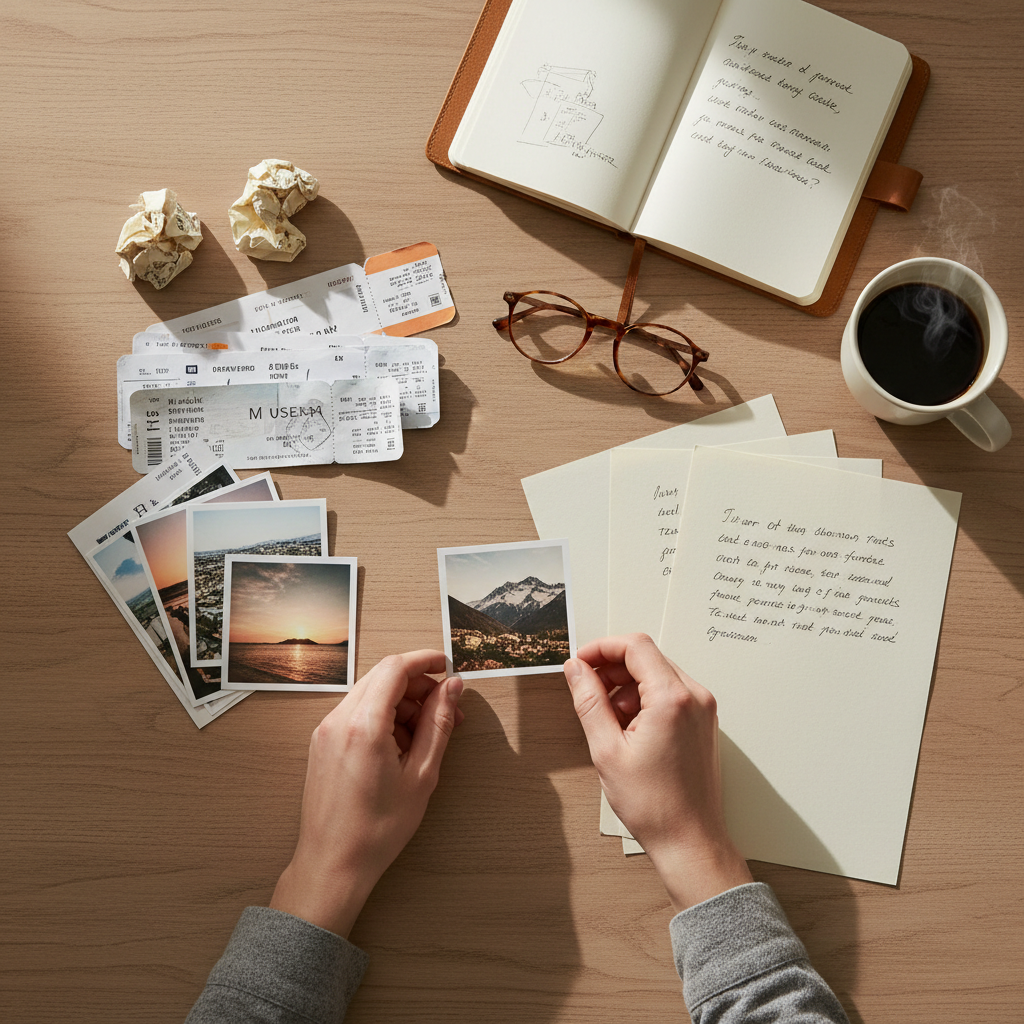
If your journal feels “flat,” the fix usually isn’t more writing, it’s more specificity. One strong detail beats ten vague sentences.
Actionable routine: a 10-minute system you can keep for any trip
If you want a simple plan, this one tends to stick because it’s small and repeatable.
- Morning (30 seconds): write today’s intention and one constraint (time, budget, weather).
- Midday (1 minute): add three micro-notes, a name, a price, a sensory detail.
- Evening (8 minutes): fill the template, choose one scene, add one photo reference.
- Optional (30 seconds): highlight one line in bold or with a marker, your “memory anchor.”
Key takeaways:
- Consistency beats volume, a short entry daily matters more than a perfect entry once.
- Write what you’ll forget first, names, routes, small feelings, tiny surprises.
- Use structure, templates remove decision fatigue.
- Protect privacy if your journal could be lost or shared.
Conclusion: keep it simple, keep it honest
If you’ve been wondering how to write a travel journal effectively, give yourself permission to write like a real person. Start with quick capture, lean on a template, and let one vivid scene carry each day. Your future self won’t care about perfect prose, you’ll care that the trip comes back to you in detail.
Tonight, try this: write a five-bullet entry for the last trip you took, then add one scene in full sentences. If that feels doable, you’ve already found your format.